Project 3: Proposal and Presentation

Updated: May 4
In the past several years, Albuquerque’s Traffic Engineering Division (NMDOT) has been working on creating safer roads for both drivers, and pedestrians. There have been many issues that have been identified and dealt with, such as speed racers who now have speed cameras, damaged roads causing cars to swerve or lose control of their car being impaired, as well as news outlets spreading awareness to the public about road safety. Many of these are still being looked into and dealt with, but there was one issue that I was unable to find any research or future work being planned for.
Traffic light timings.
Throughout my years as a driver living in New Mexico, when I drive Tramway, or most roads around Albuquerque, I deal with another common problem. Traffic lights often stop me shortly after my light just turned green or are too fast to make it through consistently, I must speed. Every day for two years I took Tramway starting from the Highway to Manitoba home. Every day was a race with traffic to see if I could make traffic lights, determining if I’d be home in 10 minutes, or in 20.
After learning more of my own finances, I have had to take gas emissions into account. Now, I take Juan Tabo home, which arguably has better light timings from my experiences. But this Tramway is not the only culprit I have seen. Lomas, Eubank, Central, and several other smaller streets on both the east and west sides of Albuquerque have made me stop shortly after I just reached speed. This is frustrating for several reasons. One, is the time taken to get to where I need. Often, I am incited to speed through certain lights I know will turn red if I go too slow. I know I am not the only one who is tempted to run red lights, as I have encountered several near crashes from others giving into the temptation. The second is gas milage. It takes more gas to start, get up to speed, stop, and then start the process again than it does to coast a consistent mileage the entire road.
To learn more about the first problem, I test-ran Tramways’ light timings by running my own experiment [Figure 1]. Here, I tested three different speeds, heading both south and north, two times each for a total of 12 drives of Tramway. On average, I stopped at a total of 7 (out of 20) lights when going south, and 6 lights heading north. To preface, there are 20 total lights among Tramway, most of these towards the northern side were triggered, so weren’t common. Central too was never hit except when I first started heading east, making it a consistent time. Taking these into consideration, this lowers the streets most likely to never hit being 15. So going South, 7 out of 15 lights were consistently hit.
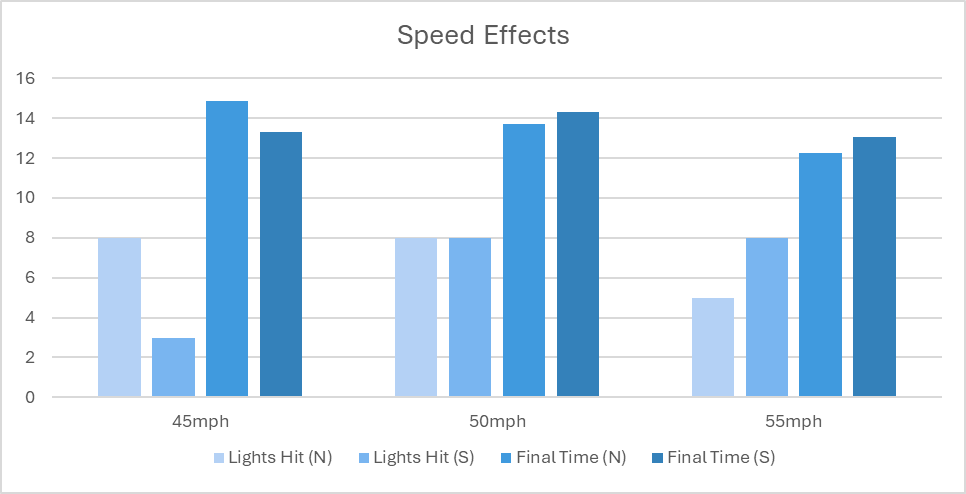
The lights most consistently hit were Montgomery, and the on ramp to I-40, next in line being Lomas, Indian School, and Spain. Montgomery has been marked by the New Mexico Department of Transportation (NMDOT) as a street that needs to be reworked due to its frequent crashes and wrong turns (DePauli).
The second problem would be gas usage. Currently, I buy mid-grade gasoline to fill my 12-gallon car, and costs about 4.5$ a gallon. Twice a month, I typically spend 50 dollars to fill three quarters. 100 dollars down the drain a month for me, because I commute to university. The best gas mileage I get is on the highway, because I can consistently go at a speed without stopping, and because of this I opt for the best traffic light timings to save on money when possible. When driving Tramway, the average lights I hit was 6-7. This may not seem like a lot at first, but often I would spend about a minute at each or lose 30 seconds due to just slowing down from lingering traffic, which can total up to 3.5-7 minutes of added time idling my car and losing time when the lights aren’t timed correctly. According to an article by Alicia on fewerdays.com, a car consumes on average about 1/4th a gallon per hour of gas when idling. So, 1/4th a gallon for 15 minutes of idle time. I lost 1/8th just driving once on Tramway. For that entire period, where I drove 12 times, I spent over 1 ½ gallons of gas on just sitting, waiting for the light to turn red.


As a better example, say you drive Tramway twice daily, five days a week, home to school, and school to home. Not taking in any other lights you hit, or streets you drive, on average the time spent idling on Tramway will be about 5 gallons a month. That is 22.5$ of 4.5$ gas per month spent on red lights. And that’s only on Tramway.
The fastest time I was able to achieve when driving Tramway was going 55mph south, where I hit only three lights, and making it in 11 minutes and 33 seconds. On average, the drive was around 14 minutes both ways, so I shaved off nearly 3 full minutes just by speeding, and admittedly, running a few yellow lights. But my time was faster. This is likely the same mentality of many drivers along Tramway, and other streets with the same problem. By speeding, and making riskier moves, you will take less time and waste less gas.
There is an example in Albuquerque where the lights are timed well, and I rarely hit a red light if I go the speed limit. Comanche, an East-West Road that actually turns off Tramway, has a posted speed limit of 35mph, and it sticks to this. It doesn’t matter which direction I am driving; once I hit a red light, I can take my time getting up to 35 mph, and the lights will turn green in time for me to roll through without stopping. Heavy traffic can cause some slowing, but if all cars are going the speed limit and react in time to lights turning green, you are almost always moving. This means less idle time for your car, less gas wastage, especially when you aren’t needing to hit the gas to fully start after a red. Well timed lights are possible in Albuquerque, they are just rare.
One last question I had was how does this all affect emergency vehicles? When I was stopped, I decided to look at the traffic at the lights. Most of the time, in the middle of the day, this was about 10-20 cars. In rush hour however, this can be much higher. Cars being stopped for minutes at a time, can stop emergency vehicles entirely in their tracks. This can delay vehicles by minutes, risking more time for a person who may be close to death. When thinking about this, I remembered I have a friend currently working as a fire fighter, with EMT experience as well. So, I asked him a few things [Figure 2].
1. How long have you worked as an EMT? Firefighter?
I’ve only been a fire fighter for about 3 months, but I’ve worked as an EMT for longer than that.
2. Where are you often located, and where do you often have the most trouble with stop lights and traffic?
I’ve been on the west side at stations 14 and 22 the most.
3. How often were you the driver in emergency vehicles, or watching where were being driven?
Since I started as a fire fighter, I haven’t driven the truck, but I do watch the road on almost every call when I get down time.
4. What are issues you often run into when dealing with traffic?
The big problem that I see happening during traffic lights is that people will see and hear us, but think they still have a chance to go because we entered the left turn only lane, but we just needed to enter a lane with no people to take a right, which a lot of people don’t see coming.
5. Have you encountered issues with traffic lights causing traffic? How do people react to emergency vehicles when at a red light? How much time is usually spent trying to navigate traffic at traffic lights?
Alot of time get spent at traffic lights due to that being where people naturally group up and wait.
This is Jackson Alvarado, who has been a friend for over 5 years now. And as he states, traffic can take up every lane, leaving emergency vehicles stuck until the light turns green. I have witnessed it myself, where cars don’t have anywhere to go because of traffic, and because the light is still red. It is frustrating for the responders, but also for the people who are waiting for help, yet they are being stopped by badly timed lights.
So how is this fixed? I do not have a degree in engineering, nor am I someone who works in construction or for NMDOT, but as a driver I have my own experience using the roads that have been built for us. So many frustrations could be alleviated through traffic light timings. By making light timings not be so quick, causing a chain of red lights if you happen to hit one, people will be able to move faster and smoother. There are also several lights littered around Tramway that are trigger based, meaning if they see a car in the intersection waiting, they will turn. Rover is a small street in between Indian School and Menaul, but I have found that if it was to turn red, then most likely the driver will also hit Indian School, Lomas, and Copper following afterwards. By changing trigger-based lights to fit the timings of other lights, not only will this help the flow of traffic on Tramway, but it will be more consistent. Often someone may just be turning right, and never needed the green light, but the light still gives it and stops all of Tramway’s traffic for one car. Making stop lights more volatile means people will need to react faster because of the unexpected change, more people stopped because of pour timing, more gas waste, and higher chances of emergency vehicles being suddenly caught in traffic.
I originally decided to look at this problem because of frustration I see my father has a lot. He is a cyclist, and an advocate for less waste in favor of preserving natural resources. One day, we were driving to get to a bike path on the west side, and a light stopped us less than a minute after the previous one. My father got frustrated, simply because he had got up to speed and then had to suddenly press the brakes for a single car to turn right. ‘A waste of gas,’ he had said, and it was something I never considered.
I have had my frustrations with the light timing around Albuquerque, and it can be debated whether it is the actual lights, or if it’s people being frustrated. I believe it is a bit of both. When driving Tramway, I was most consistently stopped when I was going 50mph; the posted speed limit. I was stopped at least 6 times, every drive, both ways. There is a discrepancy with what the light timings are, the amount of traffic, and the recommended speed. By simply changing the light timings, not only would less gas be wasted, but people will also be less impatient and volatile on the roads. By focusing on heavier trafficked roads first (like Tramway) and making sure their light timings match their speed limit, heavier traffic blocks can be avoided. For Tramway, each light would be timed to the 50mph speed limit so that once a red light turns green, by the time you are up to the speed limit the next light will be turning green. Looking back at Comanche as the perfect example, lights turned green a few minutes after the first one you hit, giving them enough time to get up to speed, and discouraging speeders who would get stopped by the next light by arriving too early. I will likely only hit 2-3 lights on Comanche, most likely one before being on the correct timing, and a few others from heavier traffic slowing down.
The change would take time, weeks of trial and error to see what lights need to be fixed. Starting with the major streets, one at a time and synchronizing to each posted speed limit, technicians can start working their way outwards from the first street they picked. Most of Albuquerque’s main roads are in a grid, so by starting in the ‘corner’, technicians can start to work their way out timing each road to each other. One road may take one week of trial and error, but with posted signs that the light’s timings are being worked on, driver’s routes will slowly begin to adjust to the light’s timings providing data for future adjustments. Often, side streets have drivers that are turning right, not even needing a red light but instead just an empty spot in traffic. There may be more delays with stop lights that were once triggered by cross-street traffic, but once they are on Tramway, the amount of time spent at one light will be made up for by a drive with little to no stops.
Adjusting the lights may require newly hired technicians, but when comparing these at the cost of saved gas, it is worth looking at. According to NMDOT, approximately 30,000 cars take Tramway on busier days. Using my earlier calculation that on average, $22.5 per month is used on idle gas usage. For 30,000 cars is $675,000 per month worth of gas idling at red lights, only on Tramway. The average annual salary of an employee working at NMDOT is approximately $89,000 per year. The amount of money spent on gas while idling could cover at least 7 NMDOT employees’ yearly salaries for a month’s worth of idle gas. To lessen that amount of money loss, several technicians could be hired to work on Tramway’s street light timings alone. It would not require new lights to be put in or built, only for their programming to be altered.
Emergency vehicles could predict and maneuver around traffic easier, and monthly gas costs would decrease. Over time, this could save lives from lessened crashes and better emergency vehicle response times, as well as decrease a significant amount of cost from idle gas usage. All while having a smoother, faster drive with less people who feel the need to speed to make it home after a long day.
Works Cited
Tramway Traffic Light Primary Source
Research Method:
To test the timings of Tramway’s traffic light timings, I tested multiple speeds, multiple times in both directions. The two locations I stopped at were The County Line at the Northern end of Tramway before it starts on a long road towards the casino. This section had no stop lights, so I did not add it to the drive. For the Southern stop, I stopped at the Smith’s on Central and Tramway, a total of 8.6 miles between the two. If looked up on maps, the drive would take 16 minutes.
I tested three different speeds. 45mph, 50mph (posted speed limit), and 55mph. I tested these three speeds, going both North and South, twice each.
Because of traffic, I could not keep a consistent speed, so for reference the stated speeds were the max speed I would go. I would pass cars if needed or stay behind. I would stop at a light if it turned yellow before the long white lines before the intersection, if it turned yellow after I had already passed or was on them, then I would continue. I counted any times that I had stopped completely or been slowed down to 10-15mph due to traffic at a recently turned stoplight. This traffic also affects timing of lights, because often if I could not get going fast enough, I would also miss the next light.
Summary:
Tramway, from The County Line restaurant to Smith’s on Central: 8.6 miles.
Stop lights (In order from North to South): Tramway LN, Cedar Hill, Live Oak, Paseo Del Norte, San Bernardino, Tramway Terrace, San Rafael, Academy, Spain, Manitoba, Montgomery, Comanche, Candelaria, Menaul, Rover, Indian School, Lomas, Copper, Encantado, Highway on/off ramp, Central.
Speeds Driven (4 times each, two North, two South):45mph, 50mph, 55mph.Each will be driven as a max speed limit, getting up to speed and letting speed control stop me from going any faster. I will pass cars if possible, otherwise my speed will stay the same in the same lane. I will not try to get to speed as quickly as possible, nor stop at the last minute. I will drive as I always have, with a new speed limit.
Traffic:I will also be noting the traffic that was there at the time, depending on the number of cars.
F (few, <5), L (little, 6-10), M (medium, 11-20), H (heavy, >20)
When a time was recorded:Whenever I came to a full stop, or was reduced to <15mph due to lingering traffic from a recently turned green light.
[Figure 1]
Data: Monday, April 27th, 2026
| North (First) |
| Time | North (Second) |
| Time | South (First) |
| Time | South (Second) |
| Time |
45mph | Start: Paseo: San Rafael: Academy: Montgomery: Comanche: Candelaria: Indian School: Lomas: Copper: Highway: Finish Time: |
F L L L F L L M M M | 9:32am 1.31min 3.19 4.39 7.06 8.44 10.01 12.37 13.42 14.35 15.42 9:50am 16m30s | Start: Paseo: Spain: Montgomery: Rover: Lomas: Highway:
Finish Time: |
L
M
M | 10:12am 2.41min Slowed 6.12 Slowed Slowed 13.16
10:25am 13m40s | Start: Central: Comanche: Spain:
Finish Time: |
F L L | 9:57am 0.03 6.11 8.38
10:11am 13m16s | Start: Central: Rover: Candelaria:
Finish Time: |
F L M | 10:31am 0.14 4.42 6.12
10:45am 13m50s |
50mph | Start: Tramway Terrace: San Rafael: Montgomery:Indian School: Lomas: Highway:
Finish Time: |
L M H M M M | 10:46am
1.59 3 6.13 6.59 9.28 10.38
11:00am 13m15s | Start: San Rafael: Montgomery: Comanche: Candelaria: Rover: Lomas: Highway:
Finish Time: |
L M M M M M M | 11:20am 2.24 5.31 6.44 7.58 9.13 11.56 13.48
11:35am 14m26s | Start: Central: Montgomery: Manitoba: Spain: Academy: Cedar Hill:
Finish Time: |
L M M M M L | 11:04am 0.11 0.52 7.51 8.54 12.51 13.31
11:17am 13m41s | Start: Central: Encantado: Copper: Lomas: Indian School: Montgomery: Spain: Academy: Paseo Del Norte: Finish Time: |
L M M M M M M M L | 11:39am 0.16 1.43 2.55 4.12 5.13 8.38 10.36 11.31
13.56 11:50am 15m16s |
55mph | Start: Tramway Terrace: Montgomery:Highway:
Finish Time: |
L M M | 11:58am
1.54 5.41 9.48
12:09pm 11m23s | Start: Paseo Del Norte: Spain: Manitoba: Montgomery:Indian School: Lomas: Highway:
Finish Time: |
M L M M M H M | 12:33am
1.18 4.30 5.13 6.35 9.50 10.58 12.52
12:46pm 13m31s | Start: Highway: Lomas: Indian School: Rover: Menau Montgomery:Spain: San Rafael: Tramway Terrace: Cedar Hill: Finish Time: |
L M M M M M L L F F | 12:13pm 0.15 1.42 2.34 3.40 4.36 6.57 8.31 10.55
11.35 12.25 12:27pm 13m50s | Start: Central: Rover: Comanche: Academy: Paseo Del Norte:
Finish Time: |
L H M M
L | 12:49pm 0.11 3.58 5.49 9.15
11.42
1:02pm 12m59s |
Analysis:
How often each light was stopped at, depending on the direction.
| North | South |
| North | South |
Tramway LN | — | — | Montgomery | IIIIII | III |
Cedar Hill | — | II | Comanche | II | II |
Live Oak | — | — | Menaul | — | I |
Paseo Del Norte | III | II | Rover | II | III |
San Bernardino | — | — | Indian School | III | II |
Tramway Terrace | II | I | Lomas | IIII | II |
San Rafael | III | I | Copper | I | I |
Academy | II | III | Encantado | — | I |
Spain | II | IIII | Highway | IIIIII | I |
Manitoba | I | I |
|
|
|
Central is marked but can be ignored because often it was a starting point after pulling out of the Smith’s parking lot. It was never red otherwise when going North. No other stop lights shared this trait and were ran into naturally otherwise.
[Figure 2]
Interview Primary Source
Jackson Alvarado
Affiliation: Friend of 5+ years
Current Profession: Fire Fighter positioned either in Rio Rancho or Albuquerque
How long have you worked as an EMT? Firefighter?
I’ve only been a fire fighter for about 3 months, but I’ve worked as an EMT for longer than that.
Where are you often located, and where do you often have the most trouble with stop lights and traffic?
I’ve been on the west side at stations 14 and 22 the most.
How often were you the driver in emergency vehicles, or watching where were being driven?
Since I started as a fire fighter, I haven’t driven the truck, but I do watch the road on almost every call when I get down time.
What are issues you often run into when dealing with traffic?
The big problem that I see happening during traffic lights is that people will see and hear us, but think they still have a chance to go because we entered the left turn only lane, but we just needed to enter a lane with no people to take a right, which a lot of people don’t see coming.
Have you encountered issues with traffic lights causing traffic? How do people react to emergency vehicles when at a red light? How much time is usually spent trying to navigate traffic at traffic lights?
Alot of time get spent at traffic lights due to that being where people naturally group up and wait.
Citations (Secondary Sources)
Alicia, A, et al. “Idling Car Gas Usage: How Much Does It Really Cost?” Fewerdays.Com, 13 Oct. 2025, fewerdays.com/how-much-gas-does-a-idling-car-use-po64/.
DePauli, Micaela. “NMDOT Plans Major Overhaul of Tramway Blvd for Safety.” NewsBreak, www.newsbreak.com/krqe-news-13-1589935/4582617234410-nmdot-plans-major- overhaul-of-tramway-blvd-for-safety. Accessed 29 Apr. 2026.
New Mexico Department of Transportation Salaries in Albuquerque | Glassdoor, www.glassdoor.com/Salary/New-Mexico-Department-of-Transportation-Albuquerque-Salaries-EI_IE41721.0,39_IL.40,51_IM17.htm. Accessed 3 May 2026.
Presentation:
Reflection:
I chose this topic because it was a personal issue I'd have daily, and I more wanted to prove that I wasn't crazy but instead that there was something actually wrong with the stop light timings on Tramway. I was writing for Albuquerque's Traffic Engineering Division (NMDOT), who are in charge of deciding what gets done for driving improvement and when. I wanted my tone to come off frustrated but reliable, providing data that proves my point rather than a mean worded rant with only my frustrations as evidence.
The written proposal is more of an argumentative essay, with points throughout the piece that are meant to be realistic, reliable, and believable. The video is more a pitch idea with steps, as to solidify and summarize what was said in the written proposal. It helps to summarize my main points, but can lack all the evidence I collected. The written proposal is the real argument, where the video project is the pitch.
I wanted to stay formal as I stated previously, while also stating my frustrations. I wanted to look at this problem from several angles, not that just hitting red lights made me angry. That is why I looked into gas prices and emergency vehicles, because this is a small problem with a lot of issues that can compound on each other. I started out by listing the state of where Albuquerque's roadways are and what NMDOT is doing, because I didn't want to say that NMDOT is doing nothing. They are making progress, and have shared statistics on Albuquerque's crash rate slowly declining. I wanted this to be something they could read that felt realistic, pointing their attention towards it as a fixable problem instead of coming off as hostile.
If I had more time with this, I would have liked to gather more data on Tramway, but also on several other streets. I would have interviewed some other friends to see which streets they may struggle with, and test those out myself using the same system. I also would have liked to spend more time interviewing Jackson, or create a survey for him to give his coworkers for more data that way, as well as any suggestions I may not have thought of.
Overall I believe my argument turned out well, despite some areas I wish I could have fleshed out with more research. In the future I likely will stick to the same format, even with the more emotional parts because when it comes to fixing problems locally, I find that people are more willing to listen if they can relate or understand. I plan to do the same sort of appeal towards readers in any further proposals I may have.
Comments